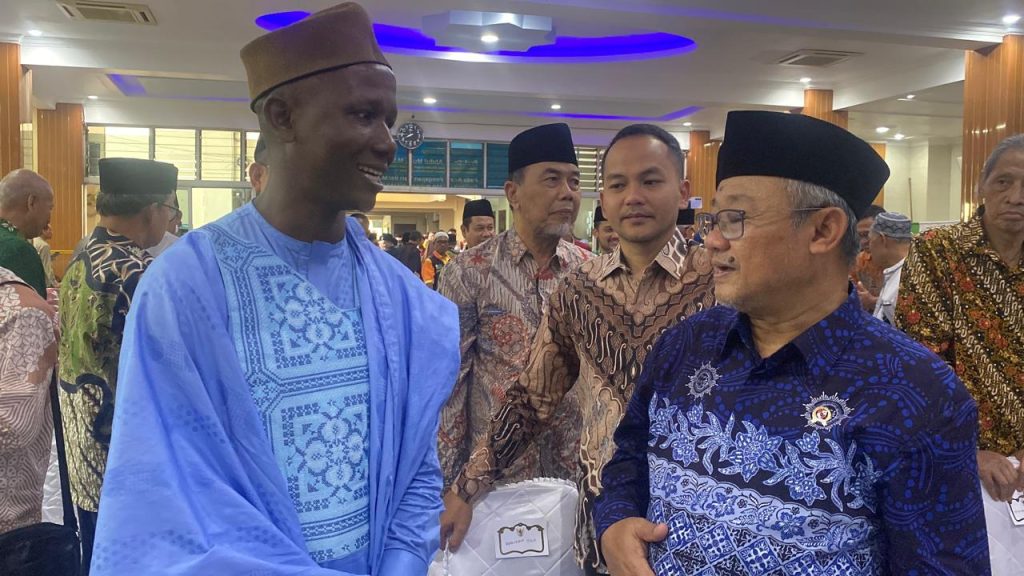
SURAKARTA, SASTRA ARAB UNS — After a religious gathering hosted by the Surakarta City Regional Board of Muhammadiyah on Sunday, May 31, 2026, Aminu Khidir found himself standing before one of Indonesia’s most prominent figures in Islamic education: Prof. Abdul Mu’ti, Indonesia’s Minister of Basic and Secondary Education and Secretary-General of Muhammadiyah’s Central Executive Board.
The brief exchange left a lasting mark on the 24-year-old Nigerian student, who is completing his undergraduate degree in Arabic Literature at the Faculty of Cultural Sciences, Universitas Sebelas Maret (UNS), Surakarta. For Aminu, the encounter was more than a moment of inspiration — it was a confirmation of a mission he has been quietly building toward for four years.
He intends to bring Muhammadiyah to Nigeria.
Four Years of Study, One Burning Conviction
Since enrolling in the Arabic Literature program at UNS, Aminu has been a consistent presence at Muhammadiyah activities — from weekly religious study circles to broader community outreach programs. What began as curiosity about the organization deepened into admiration, and eventually into resolve.
“Alhamdulillah, during my time studying in Indonesia, I have participated in many Muhammadiyah activities,” Aminu said. “I see Muhammadiyah as a remarkable organization — one that strengthens Muslim brotherhood and serves communities through education, healthcare, and a wide range of social services.”
His admiration, however, is not merely rhetorical. Aminu has a concrete plan that extends well beyond his academic obligations at UNS.
“I am very drawn to Muhammadiyah,” he said. “My plan is to establish Muhammadiyah in my country — Nigeria.”
Nigeria: A Strategic Frontier for Islamic Social Work
Aminu frames his homeland not as a distant dream, but as a field of urgent opportunity. Nigeria is the most populous nation on the African continent, and one of the dominant economic forces in West Africa — a country, in his view, uniquely positioned to benefit from what Muhammadiyah represents.
“Nigeria is one of the largest countries in Africa. Its population is large, and its economy is extraordinary,” he said. “Because of that, I believe Muhammadiyah could deliver tremendous benefit to the people there.”
He also recalled an account shared by one of his lecturers: that KH Ahmad Dahlan, the founder of Muhammadiyah, had once harbored a wish to contribute to the construction of mosques, schools, and healthcare facilities in Nigeria — an aspiration that never came to fruition in his lifetime.
For Aminu, that story carries the weight of an unfinished legacy — and a personal calling.
“Qadarullah — perhaps the moment had not yet come in those days,” he said. “But now, God willing, the time has come to build Muhammadiyah in Nigeria. I hope I can be the one to bring Muhammadiyah to my country.”
From an Arabic Classroom in Solo to the Global Stage of Islamic Mission
Aminu’s trajectory at UNS underscores what a degree in Arabic literature can become when it is lived, not merely studied. Four years immersed in the language, texts, and culture of the Arab world have formed in him not only a scholar, but a prospective envoy of transnational Islamic civil society.
His dialogue with Minister Abdul Mu’ti following the Sunday gathering brought his ambitions into a wider spotlight — a reminder that the Islamic educational mission Muhammadiyah has carried for more than a century is still finding new carriers in unexpected places.
“Thank you to Muhammadiyah, to Indonesia, and to all the people of Indonesia,” Aminu said, as the gathering drew to a close. “I hope this dream can be realized.” [adm]